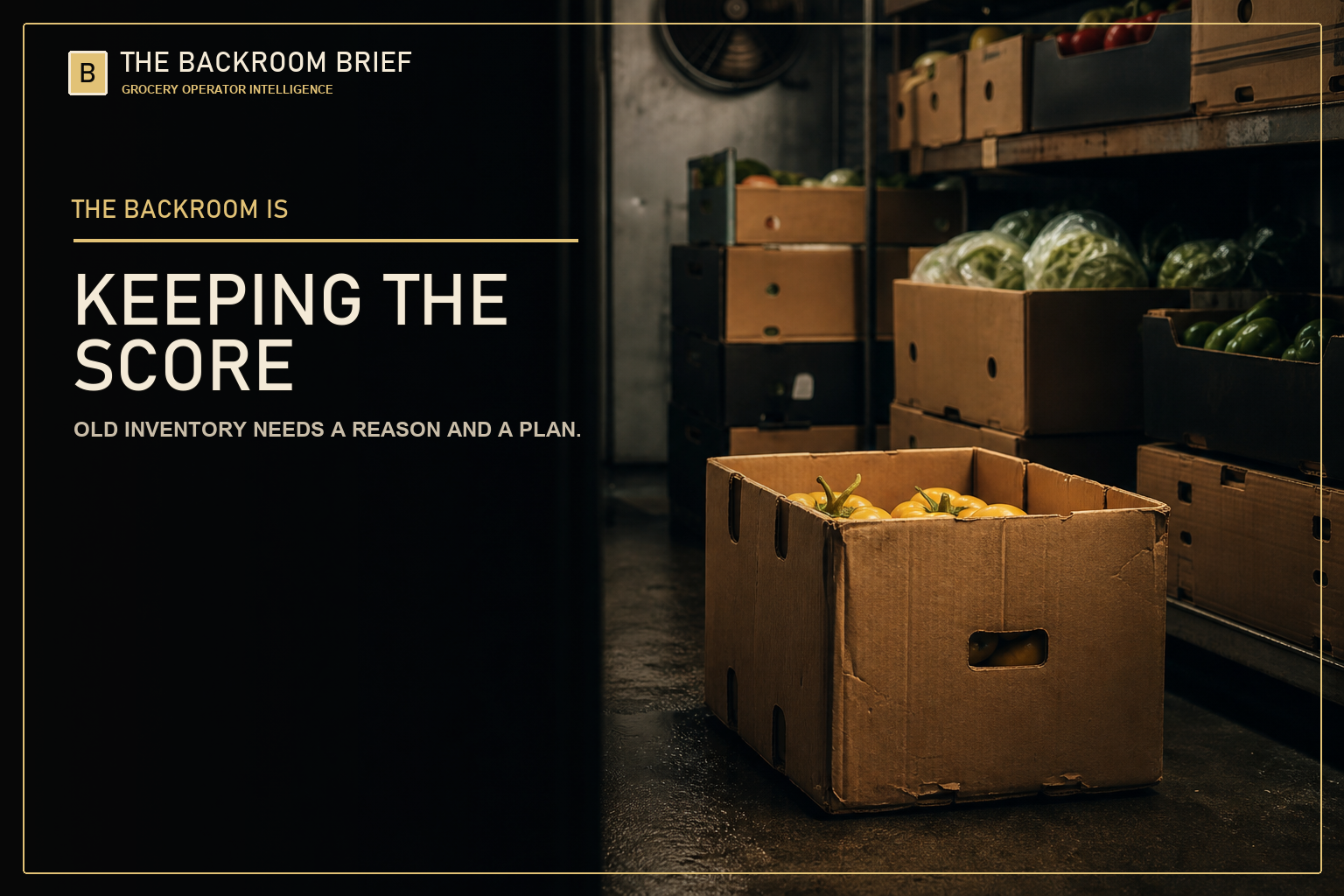
The Backroom Is Keeping the Score
Old inventory needs two answers: Why is it still here, and what is the plan to move it?
In the produce backroom, a case is pulled forward. A received date is written by hand on the cardboard. The product is still sellable. Nothing has been scanned out or thrown away.
But nobody can explain why the case is still there. New freight has arrived behind it. The order is still running. The case has been lifted, shifted, and worked around without getting any closer to the floor.
That date reveals more than age. It reveals inventory without a plan.
A case can have a legitimate reason to wait. Demand, seasonality, shelf capacity, and the product itself all matter. But when nobody knows why it is there or what happens next, the store has already lost control of it.
Case dating is one way to make that condition visible. The larger standard applies across fresh departments: every case in the backroom should still have a reason for being there.
What operators should see this week
Shrink is still discussed too often as theft after the loss has happened. The National Retail Federation includes expired goods, spoilage, damage, and administrative errors in its definition. That puts part of the shrink conversation in ordering, receiving, rotation, and replenishment, while the product still has choices left.
Fresh inventory also refuses one easy age rule. Historical USDA supermarket research found reported loss rates ranging from 4.1% for bananas to 43.1% for papayas. Those 2011-12 figures are not a current target. The spread is the useful part: a date should start an inspection, not trigger an automatic markdown or disposal. Condition, remaining sellable life, temperature, demand, and the item itself still decide the response.
The operator's job is to find the narrowing selling window before it closes.
Inventory should be able to explain itself
Writing a date on a case does not make the department disciplined. It makes the next question harder to avoid.
The order may have run too deep. Newer freight may have crossed in front. The shelf may be full, the display missing, or demand slower than expected. The age may also be completely reasonable for that item.
Look at the product before judging the date. Then ask whether the case still belongs in the plan. If it does, name the reason. If it does not, change something while the product can still sell: pause or reduce the order, bring it forward, build the right display, use a manager's special when appropriate, or escalate the problem.
This is not an argument for starving the backroom. Empty shelves create their own loss. The target is not inventory. The target is inventory that has lost its reason.
The most dangerous case is not always the oldest. It is the case that still has a chance to sell and no plan.
Dating the case and calling it control
The old case is found and dated. The cooler looks more organized. Then the next order arrives.
The store made age visible but left the decision untouched. No one changed the order, created a selling position, chose a price response, or set a return time. The case is better documented and no closer to leaving.
A date exposes the miss. It does not correct the buy or move the product. If more inventory keeps arriving after the excess is visible, the original order is still running the department after reality has changed.
Shrink starts with the case nobody can explain
The first sign of future shrink may still look like good product. The case is cold, intact, and sellable. What has disappeared is its reason for being there.
That is the point to act. Waiting removes options. The display window narrows. A manager's special becomes less useful. Another delivery turns one unexplained case into a deeper problem.
Some cases should remain in backstock. Some should be marked down, donated where feasible, or disposed of safely. Food safety always outranks recovery. The standard is not that old inventory is bad. The standard is that age, reason, plan, and ownership must still agree.
Follow one case without a plan
Choose one pressured fresh backstock area:
- Expose age. Find the oldest or most repeatedly handled case. Inspect the product itself.
- Understand why. Check the order, rotation, shelf, display, location, and inventory record.
- Decide. Keep it for a clear reason or choose the move: change the order, replenish, display, mark down, donate where feasible, dispose safely, or escalate.
- Assign. Put the response with one department-level owner and make sure the leader knows when to return.
- Verify. Come back to the physical case. Confirm that it moved, the order changed, the shelf filled, the record was corrected, or the problem was escalated.
Do not close the walk with an explanation. Close it with a changed physical condition.
One check before Monday gets loud
Pick one pressured backstock area on Monday. Find one sellable case that has been there long enough to deserve a question.
Ask the department head:
Why is it still here?
What happens next?
Agree on the response, the owner, and the return time. When you come back, find the case instead of asking whether someone handled it.
Monday sentence: A scan-out records the loss. A backroom walk can still change it.
Operator question: Where is your store carrying inventory that still has selling life but no active plan?
Get the Friday Brief, one sharp grocery operator read and one practical move every week. Subscribe free and receive the Store Walk Standard in the welcome email.
Forward this to the operator who can still change what the backroom is showing.
Get the Friday Brief