
The Recovery Window
A store can be technically staffed and still have no capacity to recover.
The store opens on time. The departments do not.
Produce is still trying to get up and running. Bakery production is behind its normal rhythm. Deli breakfast is thinner than it should be. Customers are already shopping, but the opening team is spending its best hours on yesterday.
Most bad mornings do not start with a crisis. They start when an ordinary night changes, attention moves somewhere else, and no one resets the priorities. A few calls never get made, and the opener gets a list without enough explanation.
By morning, unfinished work has become today's labor plan.
A schedule can look covered while the next shift is already paying for work left behind. That catch-up either ends at the close or rolls into the morning.
1. Retail is producing more with fewer hours
U.S. retail productivity increased 2.9% in 2025. Output rose 2.5% while hours declined 0.4%.
This is retail-wide context, not a grocery staffing verdict. But it helps explain why the final hour of a shift has become one of the most valuable hours in the building. When the day runs long, recovery work at the edge of the schedule is often squeezed first.
On the floor: Decide in advance which department condition the final labor hour must protect, who owns it, and what may wait.
2. Storewide coverage can hide a department-level miss
National Grocers Association guidance argues that labor forecasting must reach the department and the hour, not stop at a store total.
A schedule can balance while produce lacks reset overlap, bakery loses preparation time, or deli carries unfinished work into breakfast.
On the floor: Identify the department and daypart where a missed reset costs the next shift most. Protect that window before moving labor elsewhere.
3. The hardest closing moments require judgment
OSHA notes that extended or irregular schedules can contribute to fatigue and reduced alertness.
Closing shifts often have the newest associates. When something unfamiliar happens, it can take over the night while the regular closing work gets missed.
On the floor: Make sure every closing PIC knows what must get done, what they can decide, and who to call when the night changes.
The schedule cannot tell you whether the department can reset
A schedule only tells you who is there. It does not tell you whether the crew has enough time or experience to finish the close, or whether the PIC can change the plan when the night goes sideways.
The close sets up the next morning. When it misses, the opening team has to clean up yesterday before it can get ready for today.
A weak close makes the store pay for the same work twice, and the second time usually lands in a busier part of the day.
Leaving a list without leaving a decision system
A closing list works when the night goes as expected.
Then freight arrives late. Business holds. Equipment acts up. A customer problem takes time. Something unfamiliar becomes the center of the shift because the closer has not yet learned how to size it.
That is not an associate failure. It is a leadership test.
A newer closer needs more than a checklist:
| • | Tonight's top priorities |
| • | The condition the opener must not inherit |
| • | What can safely wait |
| • | What the PIC can decide |
| • | What requires escalation |
| • | What must be documented if work remains |
The list handles the routine. The leader helps when the night goes sideways.
The assigned hour does not always stay assigned
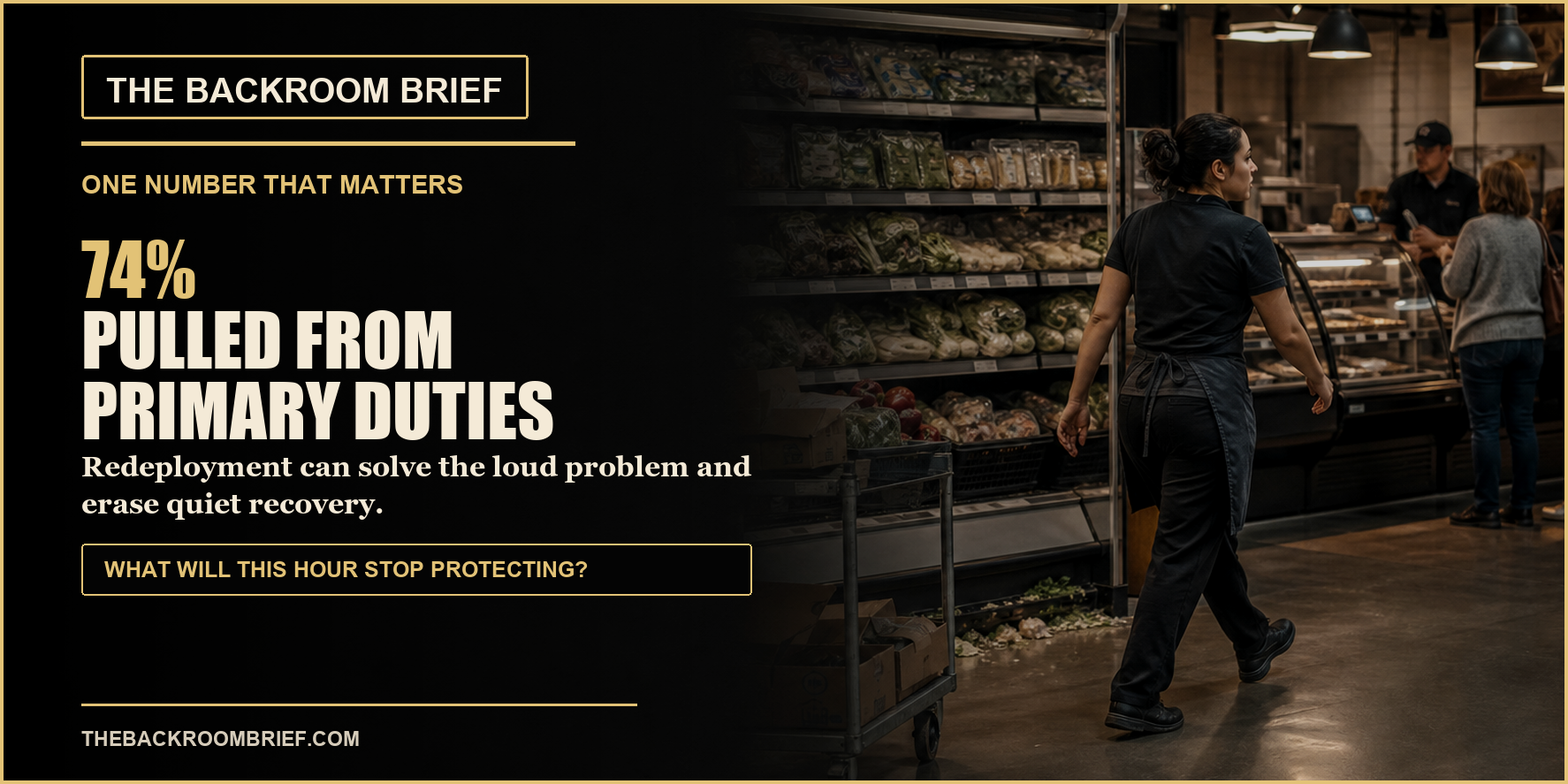
In a 2025 Logile survey conducted through Pollfish, 74% of 500 U.S. retail associates said they had been pulled from primary duties to cover gaps elsewhere.
This was a vendor survey, not a grocery benchmark. The useful point is that moving one person can erase the reset time the schedule appeared to protect.
Before pulling someone, ask: If I move this person, what is not getting done?
Every department needs an owner of the close
When the night changes, the PIC has to reset the plan: what still has to get done, what can wait, who needs a heads-up, and when a leader will check back.
Every close needs one person who can say, “We are not finishing everything tonight. Here is what matters most.”
The leader cannot prevent every disruption. The job is to make a clear call, communicate what changed, and come back to see how it turned out.
TBB's point of view
The most expensive hour may be the one the opening team spends doing work the close did not finish or explain.
An honest labor plan shows what got done, what got pushed, who made the call, and what the opener is walking into.
Audit one close-to-open handoff
Choose the department most likely to lose tomorrow morning when tonight gets tight.
| 1. | Name the window. When does the reset have to happen? |
| 2. | Set the standard. What must the opener walk into? |
| 3. | Name the PIC. Who owns the close? |
| 4. | Know who to call. What requires help from a leader? |
| 5. | Leave the note. What remains, why, and what changed? |
| 6. | Check it in order. Look at the department first; then read the notes. |
The notes should explain what you already saw, not shape the walk.
Protect one recovery window
At Monday's huddle, pick the department that most often starts behind and agree on what the opener should walk into.
The next morning, walk the department before opening the notes. Compare what the closer wrote with what the opener found. Coach the miss, reset tonight's priority, and check it again before the next peak.
The close is not finished when the list is checked. It is finished when the opener can start today's work.
Get the Friday Brief for one hard-earned operating read and one thing to check in your store next week.
Forward this to one operator who owns the close-to-open handoff.
Get the Friday Brief
