Through Their Eyes
The best store walk you will ever do is the one you take as a customer.
Tomorrow morning, before you check yesterday's sales, hunt holes, ask about freight, or walk the backroom, go outside.
Start in the parking lot. Grab a cart. Come through the front doors as if you have never worked a day in the building.
Do not explain anything away.
The customer does not know about the late truck, the callout, or the display that was full an hour ago. The customer crosses the threshold, sees the first display, looks into produce, and begins forming a feeling.
Welcoming or chaotic. Fresh or tired. Easy or harder than it should be. Ready or still catching up.
For twenty minutes, forget what it took to open the store. Experience what the work created.
Customers never compare today's trip to yesterday's truck. They compare it to every other place they could have shopped.
This issue is about the gap between what operators understand and what customers experience - and the one walk that can close it.
1. Customers remember one trip, not separate departments
The American Customer Satisfaction Index scores supermarket layout and cleanliness at 83, meat and produce freshness at 83, merchandise availability at 82, staff courtesy and helpfulness at 81, and checkout speed at 79.
Why it matters: Operators manage departments. Customers remember the trip. Strong produce can earn confidence early, but an unavailable staple, confusing service handoff, or difficult checkout can rewrite the memory before the customer leaves.
What changes on the floor: Walk the handoffs, not only the departments. Watch what the customer experiences from entrance to produce, aisle to service counter, and checkout to exit. The weak handoff often matters more than the strongest individual score.
2. Enrollment is not the same as loyalty
Upside reports that 74% of surveyed consumers belong to a grocery loyalty program, yet its transaction analysis says 31% of customers shopping in a given month will not return that year. The point for operators is simple.
Why it matters: A customer can scan a loyalty card, receive an offer, and still leave unconvinced about the next trip. The card identifies the shopper. The experience decides whether the relationship continues.
What changes on the floor: Stop treating enrollment as the finish line. Fresh condition, availability, service recovery, and checkout ease still have to earn the return visit. After the walk, ask one harder question: What happened today that gave this customer a reason to come back?
3. Checkout speed is a customer feeling
NCR Voyix found 77% of self-checkout users prefer it because it feels faster.
Why it matters: Customers are not grading the labor model or lane strategy. They are grading whether the ending felt clear, supported, and respectful of their time. A fast system can still feel slow when help is hard to find.
What changes on the floor: Walk the front end from the customer's side during a peak window. Can shoppers see where to go, understand what is open, get help quickly, and leave without one final irritation? Staff for the moments that interrupt flow, not only the transactions moving through it.
Three different signals point to the same operator truth: customer experience is not a soft idea. It is how layout, fresh, availability, service, and checkout become a reason to return.
The customer does not shop the org chart
A heavily shopped front display can tell the team, "We sold a lot." To the customer, the same display can say, "This store is chaotic and unprepared."
That gap rarely comes from a lack of care. It comes from familiarity. A display still has product, so we stop seeing the broken edge. Produce looked strong at opening, so we remember 7 a.m. instead of seeing 4 p.m.
The customer sees the condition now.
Parking lot, carts, entrance, produce, center store, service counters, checkout, and exit collapse into one judgment about whether the store cares.
Produce is one of the fastest credibility signals. When quality is off and outs stay open, the concern travels beyond the department. When produce stands tall and the first twenty feet feel alive, the whole store earns confidence before aisle one.
Customers do not remember how hard the week was. They remember how the trip felt.
The best operators understand that every decision - labor, ordering, recovery, merchandising, signing, and service - eventually becomes a customer experience.
Great operations should feel effortless to the shopper
The work behind a strong store is never effortless. It is freight, production, schedules, recovery, coaching, cleaning, filling, and fixing.
But the customer should not have to carry the strain.
A clean restroom becomes trust. A full produce table becomes confidence. A clear sign becomes relief. A helpful employee becomes reassurance. A fast, supported checkout becomes respect for the customer's time.
The best store walk is not the one that finds the most faults. It is the one that closes the gap between what the operator understands and what the customer feels.
What did you walk past?
A leader sees a crooked sign near the entrance. It would take less than a minute to straighten, but there is a call waiting and freight still on the floor. The leader keeps moving.
Nothing dramatic happens. That is why the moment matters.
Walking past a two-minute miss teaches the store that noticing is enough. It is not. If the miss takes less than two minutes, fix it or get it fixed now. If it takes longer, write it down, name an owner, and circle back.
Memory is not follow-through. A walk without ownership can become a tour of things everyone already knows.
The goal is not perfection. Stores get shopped. Displays break. Product sells. The standard is response: how quickly the team notices what changed and restores the feeling of control.
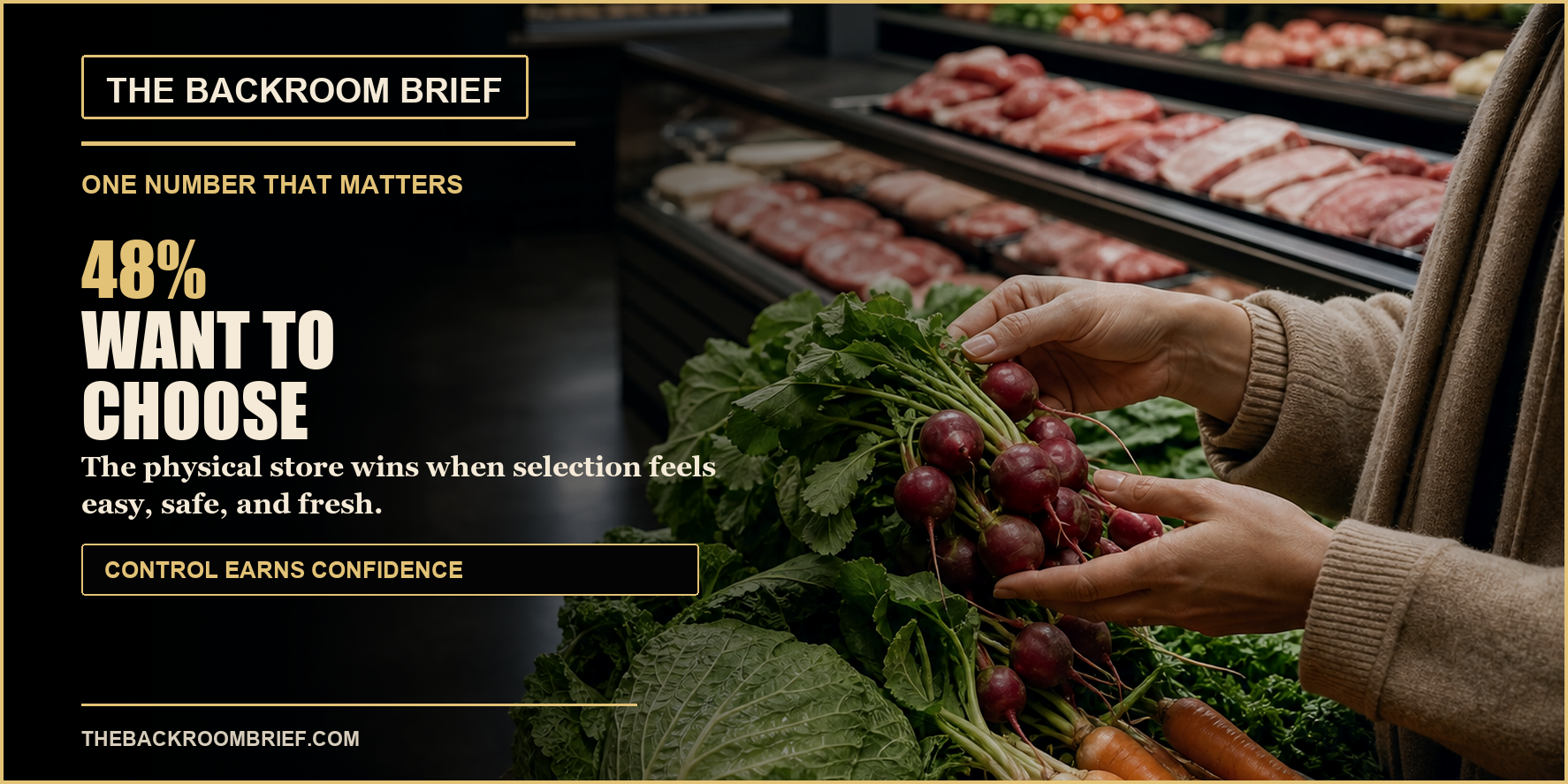
The in-store advantage no app can replace
In FMI's 2026 shopper research, 48% said the thing they would most miss if they could no longer grocery shop in person was the ability to select products themselves.
That is not nostalgia for a building. It is a need for control.
Customers want to inspect produce, compare marbling, check a date, and choose the right package. The physical store wins when that choice feels easy, safe, and fresh.
Walk the moments where selection requires confidence. If the case is tired, the sign is unclear, or the aisle makes comparison difficult, the store weakens one of its strongest remaining advantages.
Take the trip before you manage it
Start at the edge of the parking lot. Is the arrival clean and welcoming? Grab a cart. Is it the first tool of an easy trip or the first irritation?
Cross the threshold slowly. Let the first display make its argument. Does it feel intentional now, or does the team remember how it looked when it was built?
Enter produce. Look at the first twenty feet as evidence. Does quality stand tall? Are outs becoming the loudest thing in the department? Does the store feel alive?
Can a first-time shopper find dinner, understand the signs, move easily, and know where to get help?
Finish at checkout. Do not grade the front end by the schedule. Grade the ending by the customer's effort.
Hold the store near 85% of grand-opening condition - not untouched perfection, but a standard that refuses to normalize drift while respecting that real stores get shopped.
Turn one observation into one ownership decision
Bring one condition from the customer-eyes walk into Monday's huddle. Not the whole list. Choose the one condition most likely to change how the trip feels.
Ask the team:
- What might the customer feel when they encounter this?
- Where does that feeling begin in the trip?
- Who owns the recovery?
- What will visibly look or feel better by noon?
Name one owner, one standard, and one return time. Then revisit the condition after the next peak window.
The test is not whether the team can see the miss. The test is whether the walk changes what happens next.
Service is the result the customer feels
Grocery is not only stacking cans, filling tables, and moving freight. It is a service business carried through conditions.
Customers may never see the associate who culled the rack, the manager who rebuilt the front display, or the cashier who stayed to clear the line. They experience the result every step of the trip.
If we do not take care of the customer, someone else will. The customer has choices and remembers how the trip felt.
The work may be invisible when it is done well. The care is not.
The customer never sees the explanation. They only feel the result.
Subscribe to The Backroom Brief for one operator insight, one store walk, and one practical action every Friday.
Forward this issue to one operator who should walk through the front door before walking the backroom.
Forward This Brief